
Why You Clicked That Headline Even Though You Knew Better
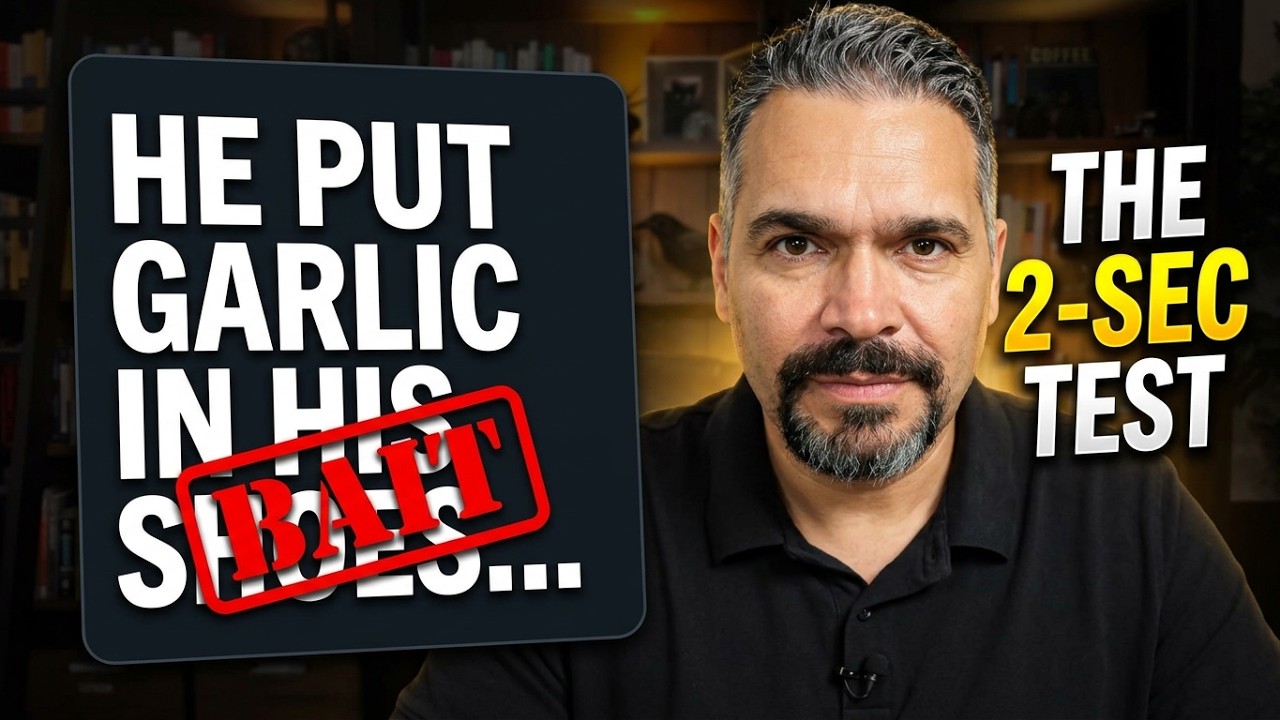
Three moves, one question, and the line between a story and bait.
The short version
- Clickbait works because a missing piece of information feels like an itch, and the headline is built so that clicking is the only way to scratch it.
- Bait headlines use three moves: they hide who the story is about, point at the answer instead of giving it, and tell you how to feel about something they won't show you.
- Before you click, ask whether you can say what the story is about from the headline alone. If you can't, the writer left it out on purpose.
You know the one. You’re scrolling and a headline says, “He Put Garlic In His Shoes Before Going To Bed And What Happens Next Is Hard To Believe.” You know it’s going to be nothing. You click anyway. It’s nothing. You close the tab feeling a little dumb, and forty seconds later you do it again.
For 30 years I wrote headlines and email subject lines for a living, and the job was scored on one number: how many people clicked. I’ve built lines like the garlic one on purpose and tested them against plainer versions. So here’s how they’re put together, and a quick check that tells you whether a headline is informing you or holding something back.
Why it works: the curiosity gap
The trick is older than the internet. In 1994, a Carnegie Mellon psychologist named George Loewenstein reviewed decades of research on curiosity and landed on a simple explanation. Curiosity shows up when you notice a gap between what you know and what you want to know. The important part is how that gap feels. It’s less like interest and more like an itch, a small sense of something missing that you want to close.
Loewenstein called it an information gap. I call it the curiosity gap.
Look at the garlic headline again. It tells you almost everything: a man, garlic, shoes, bedtime. The only thing missing is what happened. That missing piece is the itch, and clicking is how you scratch it.
The three moves
Once you know these, you’ll see them every time you read a bait headline.
Move 1: Hide the who. The headline won’t tell you who the story is about. You get “he,” “this celebrity,” or “a common household item.” You get most of the story, minus the one word that would tell you whether you care.
Move 2: Point at the answer. The headline doesn’t say what happened. It tells you the answer is one click away: “what happens next,” “here’s why,” “the reason will surprise you.” In 2015, two Danish researchers, Jonas Blom and Kenneth Reinecke Hansen, studied 100,000 headlines and gave this move a name: forward reference. The headline points ahead at the article instead of telling you what’s in it. They found it most on sites that depend on clicks to make money.
Move 3: Promise a feeling. “Hard to believe.” “Priceless.” “Left everyone speechless.” The headline tells you how to feel about something it won’t show you.
The garlic headline uses all three. Who is “he”? That’s move one. “What happens next” is move two. “Hard to believe” is move three.
And here’s the twist. Facebook itself published that exact headline in 2016, as an example of what it was trying to push down in people’s feeds. A company that makes money on attention went after the most reliable click on the internet. Its stated reason was simple: people had told Facebook they wanted to see fewer stories with clickbait headlines.
Running the Source Test on a headline
Every bait headline makes you a promise: there’s something here worth your click. On this channel we run the Source Test on promises like that.
Stake: who gains if you believe it? The publisher. They get paid when you click, not when you’re glad you clicked. The article can be nothing and they still got paid, so there’s no reason for it to be good.
Source: how do we know this is done on purpose and not just lazy writing? Two pieces of proof. First, when Facebook built its 2016 filter, a team read thousands of headlines by hand and sorted out the clickbait using two questions: does the headline hold back what the story is about, and does it oversell it? Then Facebook built a filter to catch those phrases, the way your email catches spam. Nobody builds a spam filter for an accident.
Second, Upworthy, the site that made this style famous, tested its headlines like a lab. Researchers later published the archive: more than 32,000 experiments and about 150,000 headline versions shown to readers hundreds of millions of times. The winners became the headlines you remember from 2013.
Steelman: what’s the best case for the other side? Opening a gap isn’t a crime. Every mystery novel does it. Every good teacher does it. I did it at the start of the video. A headline that told you everything would be a summary, and nobody clicks a summary. So the gap by itself isn’t the trick.
The fill-in-the-blank check
Here’s the whole trick in two sentences. A gap the story fills is a good story. A gap the story never fills is bait.
You can tell which one you’ve got before you click. Ask one question: can I say what this story is about, just from the headline?
“When she looked under her couch cushions and saw this, I was shocked.” Saw what? You can’t say. Bait.
“The dog barked at the delivery man and his reaction was priceless.” What reaction? You can’t say. Bait.
The garlic one? You still can’t say what happened. Only the writer knows, and the writer left it out on purpose.
The honest part
You’d think this trick would cost a news site your trust. I looked for proof of that, and it isn’t clean. In 2016, researchers at the University of Texas showed headlines to about 2,000 American adults. Some were plain, some were questions, and some pointed at the answer like the ones above. The question headlines got slightly worse reactions. The ones that pointed at the answer didn’t: people rated them about the same as the plain ones.
So using this trick doesn’t reliably hurt the site, and that’s a big part of why it’s everywhere. The site doesn’t pay for it. You do, forty seconds at a time.
I’ll own my part. I open a gap at the start of every video I make, on purpose. The difference is that I tell you what you’ll get before I ask for anything, and then I give it to you. The gap gets filled. That’s the line between a story and bait, and I’d hold everyone to it, including me.
Sources
- Loewenstein, G. (1994). The Psychology of Curiosity: A Review and Reinterpretation. Psychological Bulletin 116(1), 75–98.
- Blom, J. N., & Hansen, K. R. (2015). Click bait: Forward-reference as lure in online news headlines. Journal of Pragmatics 76, 87–100.
- Peysakhovich, A., & Hendrix, K. Facebook Newsroom (Aug. 4, 2016). Further Reducing Clickbait in Feed.
- Matias, J. N., Munger, K., Aubin Le Quere, M., & Ebersole, C. (2021). The Upworthy Research Archive. Scientific Data 8, 195.
- Scacco, J. M., & Muddiman, A. (2016). Investigating the Influence of “Clickbait” News Headlines. Center for Media Engagement, University of Texas at Austin.
What's the worst clickbait headline you fell for this week?
Read the full transcript
Lightly cleaned from the YouTube captions: misheard words fixed, filler trimmed where it broke the sentence. Everything else is as spoken.
So you know when you're scrolling on your phone or checking the internet on your computer, and you come across a headline that says something like "He put garlic in his shoes before going to bed. And what happens next is hard to believe." You know it's nothing, right? But you click anyway, and it's nothing. So you close the tab, feeling a little dumb. Forty seconds later, you do it again. So I'll start with my own title. Take a look at it. Can you tell what this video is about from the title alone? You can. Hold on to that, because by the end of this video, you'll know exactly why most headlines are written so you can't tell what they are.
I'm Allen Stafford, and I help people think clearly in a noisy world. This is Think Sharper. Look, for 30 years I wrote headlines and email subject lines pretty much for a living. And the job was scored on just one number: how many people clicked it? I've built lines like the garlic one we just talked about on purpose, and tested them against plainer versions. So what I'm going to do is show you the construction from the inside. Here's what you're walking out of this video with: a two-second check you can run on any headline that tells you whether it's informing you or withholding from you, and the exact part of the sentence that's doing the withholding.
So let's start with why it works, because the trick is older than the internet. In 1994, a psychologist at Carnegie Mellon named George Loewenstein reviewed decades of research on curiosity, and he landed on a simple account of what it is. Curiosity shows up when you notice a gap between what you know and what you want to know. And the part that matters for us is how that gap feels. It's less like interest and more like an itch, a small deprivation you want to close. He called it an information gap. I'm going to call it a curiosity gap, and that's the one term we need today: the itch you feel when you know a fact is missing and you know exactly where it is. Look at the garlic headline again. It tells you almost everything. A man, garlic, shoes, bedtime. The only thing missing is what happened. That missing piece is the itch, and clicking is how you scratch it.
So there are three moves, and once you know them, you're going to see them every time you read one of these clickbait headlines. The first move is Hide the Who. The headline won't tell you who the story is about. Instead you get things like "he," or "this celebrity," or "a common household item." So you get most of the story. You just don't get the one word that would tell you if you care.
Move two is Point at the Answer. The headline doesn't say what happened. It tells you the answer is one click away: "what happens next," or "here's why," or "the reason will surprise you." Two Danish researchers, Jonas Blom and Kenneth Hansen, studied 100,000 headlines in 2015 and gave this move a name: forward reference. The headline points forward at the article instead of telling you what's in it. They found it most on sites that live on clicks alone.
And move three is Promise a Feeling. Things like "hard to believe," or "priceless," or "left everyone speechless." The headline tells you how to feel about something it's not going to tell you.
Now let's watch all three in one sentence. "He put garlic in his shoes." Who is he? I don't know. That's move one. "And what happens next?" That's move two. "It's hard to believe." That's move three. And here's the twist. Facebook itself published that headline in 2016 as an example of what it wanted off the platform. So why would a company that makes money on clicks fight the most reliable click there is?
Every one of these headlines is making you a promise: there's something here worth your click. So we're going to run the Source Test on that promise. First, the Stake: who wins if you believe it? The publisher wins. And here's how the money works. They get paid when you click. Not when you're glad you clicked, but when you actually click. So the article can be absolutely nothing, and they still got paid. There's no reason to make the article any good.
Next, the Source: how do we know this is done on purpose and not just lazy writing? Two pieces of proof. First, in 2016, Facebook had a team read thousands of headlines by hand, not through a computer, and sort out the clickbait. Their test was simple. Does the headline hold back what the story is about? Does it oversell it? Then they built a filter to catch those phrases, the same way your email catches spam. You don't build a spam filter for an accident. And second is Upworthy, the site that made this style famous. It tested its headlines like a laboratory: 32,000 experiments, 150,000 headline versions, over 500 million views. And the winners became the headlines you remember from 2013.
Then we run the Steelman: what's the best case for the other side? Opening a gap isn't a crime. Every mystery novel does it. Every good teacher does it. I did it to you about ninety seconds ago in this video. A headline that told you everything would be a summary, and nobody clicks a summary. So the gap by itself isn't the trick.
Here's the whole trick. A gap the story fills is a good story. A gap the story never fills is bait. And you can tell which one you've got before you click. You just ask one question: can I say what the story is about just from the headline? So let's try it. "When she looked under her couch cushions and saw this, I was shocked." Saw what? You can't say. So it's bait. "The dog barked at the delivery man and his reaction was priceless." What reaction? You can't say. Bait. And the garlic one? You still can't say what happened. Only the writer knows that, and the writer left it out on purpose. Now try my title: "Why You Clicked That Headline Even Though You Knew Better." Can you say what the video is about? Yes. You could have skipped it, but you chose to click on it. And that's the entire check. Can I fill in the blank?
If you want the full Source Test on a simple card you can pull up while you're scrolling, I made it a free one-page download. It's on my website, and the link is below. Grab it now, before you get on to your next headline.
So now for the honest part. You'd think this trick would cost a news site your trust. I looked for proof of that, and it isn't very clean. In 2016, researchers showed headlines to about 2,000 American adults. Some headlines were just plain, regular old headlines, some were questions, and some pointed at the answer, like the ones we've been looking at. The question headlines got slightly worse reactions. The ones that pointed at the answer didn't. People rated them about the same as the plain ones. So using this trick doesn't reliably hurt the site, and that's a big part of why it's everywhere. The site doesn't pay for it. You do. Forty seconds, and that feeling of being a little dumb.
And here's the part I owe you. I've written these lines myself. I did it to you in this video. In the first few seconds, I told you to look at my title and hold on to a question. That's the curiosity gap. I opened one on purpose, and I do it in every video I make. So what makes mine different from the garlic headline? You can check it yourself. I told you what you'd get before I asked you for anything, and then I gave it to you. The gap got filled. That's the line between a story and bait. Hold everyone to that line, including me. Think Sharper. Stay Sovereign.
More from Media Literacy

One tactic, one tool, every week
The newsletter walks through each video in a few minutes of reading. Free, and easy to leave.