
Season 1 · Episode 4
Lemmings Don’t Jump. Disney Pushed Them.
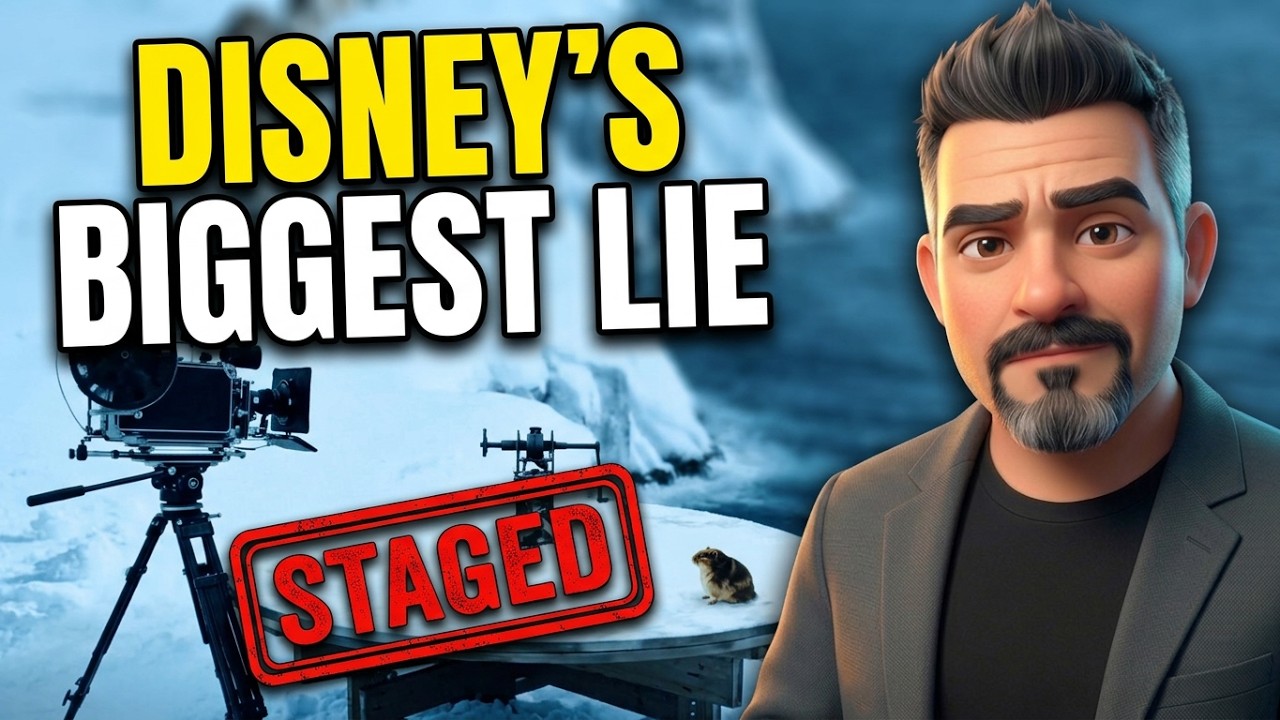
How the famous lemming-suicide footage was staged, why the idea is centuries older than the film, and what really happens to lemmings.
The short version
- The famous lemming-suicide footage in Disney's White Wilderness (1958) was staged: a small group of lemmings on a snow-covered turntable, forced off a cliff into a river in landlocked Alberta. The film won an Oscar.
- But the film didn't invent the myth. People believed strange things about lemmings for centuries, an 1877 magazine had them perishing "voluntarily, or at least instinctively," in the ocean, and a 1955 Disney comic showed them leaping off cliffs.
- Something real does happen: lemming populations boom and crash, crowded lemmings disperse, and in big migrations many drown. No one has documented a lemming choosing to die.
Here’s something everybody knows: lemmings, those small furry Arctic rodents, follow each other blindly. When there get to be too many of them, they pour across the tundra in a furry river and throw themselves off cliffs into the sea. It’s why we call mindless followers “lemmings.”
That’s the lemming suicide myth. No one has documented a lemming choosing to die. And if you already knew that, you probably also know the popular correction: Disney faked it. That correction is half right, and the half that’s wrong is the more interesting half.
The lemming as an insult
The lemming stopped being an animal a long time ago. It’s a word for a follower with a death wish. Investors piling into a bad stock are lemmings. Everyone buying the same trend is a lemming. In 1991, Lemmings, one of the best-selling video games of its era, made a whole game out of stopping a stream of tiny creatures from marching off ledges to their doom.
For a lot of people, the picture came with proof. In 1958, Disney released White Wilderness, part of its “True-Life Adventure” nature series. On the big screen, audiences watched lemmings march across the snow, reach the edge and tumble into what the film presented as the Arctic sea. It won the Academy Award for Best Documentary Feature. If an Oscar-winning nature documentary shows it, it must be real.
How the scene was really made
In 1982, the CBC’s investigative program The Fifth Estate aired Cruel Camera, reporter Bob McKeown’s investigation of animal cruelty in the film industry. It helped expose how the lemming scenes were made, and the answer was worse than most people guess.
The film was shot in Alaska, Alberta and Manitoba, but the lemming sequence was staged in Alberta, a landlocked province nowhere near an ocean. The lemmings weren’t wild migrants. They were reportedly gathered in Manitoba, with local children paid to help (25 cents, by one cameraman’s account; a later BBC piece says a dollar a lemming), and brought south. They weren’t even the right lemmings: the famous migrations involve the Norway lemming, and accounts agree the film used a different kind, though they differ on which.
The epic migration was a small group of lemmings on a snow-covered turntable, filmed to look like a horde. The “sea” was the Bow River, near Canmore, shot to pass for the Arctic Ocean. And the lemmings didn’t jump. The crew forced them off the cliff, pushing or throwing them by most accounts (one scientist told the BBC they were tipped from a truck), filmed them struggling in the water, and the narration presented it all as nature at work.
Who at Disney knew is another question. The Walt Disney Family Museum says the crew acted without the knowledge or approval of Walt and the studio. The museum isn’t a neutral source, but that’s the claim on record.
So the smart crowd’s correction, that the scene was staged, is right. Where it goes wrong is the next step: “Disney invented the lemming suicide myth.”
The myth is older than Disney
People believed strange things about lemmings for centuries before anyone pointed a movie camera at one.
In 1532, the geographer Jacob Ziegler reported that lemmings fell from the sky during storms and died when the spring grass grew. About a century later, the Danish naturalist Ole Worm accepted that they might fall from the sky, probably carried by the wind, but then did something radical for the time: he examined specimens and found they looked a lot like voles and hamsters. Ordinary rodents.
In August 1877, Popular Science Monthly ran W. Duppa Crotch’s essay “The Norwegian Lemming and Its Migrations.” It claimed that the migrating swarms perish “voluntarily, or at least instinctively,” in the ocean, and suggested that land could once have existed where the Atlantic now rolls, with Atlantis as his example. In 1951, C. M. Kornbluth’s science-fiction story “The Marching Morons” built its plot on the idea, with a character explaining that “every few years they’d swarm to the coast and swim out to sea until they drowned.”
And in 1955, three years before White Wilderness, the Disney comic The Lemming with the Locket, drawn by Carl Barks, already showed lemmings leaping off Norwegian cliffs. Barks said he got the idea from something he read in the paper, then read more in National Geographic and other places.
So the filmmakers didn’t invent a myth from nothing. The story was already in print and already in a Disney comic when they staged it. Nobody has documented what they believed or who ordered it. But the staged footage gave the old story its most convincing image, and that image outlived its own exposure.
What lemmings actually do
The “it’s all fake” crowd misses one more thing: something real does happen. Lemming populations swing wildly, booming and crashing every three to five years in many populations, for reasons scientists still haven’t fully explained. When an area gets crowded and the food runs out, lemmings disperse, sometimes in large numbers, looking for somewhere better.
Lemmings can swim, and they cross streams and lakes. In Norway, Hinterland Who’s Who says, large numbers can end up reaching the sea or a large lake, and may go out onto the ice or jump into the water. Some drown, and in the big Norwegian migrations, 19th-century writers reported thousands drowned in rivers and fjords. So people really did see dead lemmings. They just told themselves the wrong story about why. Asked whether lemmings kill themselves, zoologist Gordon Jarrell put it plainly: “No. The answer is unequivocal, no they don’t.”
The thing to take with you
Stack it up. The myth: lemmings commit mass suicide. Wrong. The correction: Disney invented it as a hoax. Also wrong. The truth: a long-running misreading of a real event (boom, crowding, dispersal, drowning) that a film crew then staged for the camera.
And look at what it took. A river, framed to look like the sea. A turntable, framed to look like the tundra. A small group of animals, framed to look like a horde. The narration told its share of untruths, calling a river the Arctic sea, but the pictures did the convincing. It depended on where the camera pointed and what it left out.
That’s worth keeping, because every photo, clip and “you have to see this” video is a choice about the frame. Next time footage seems to prove something perfectly, ask what’s just outside the frame. And remember: people rarely fake things out of nothing. They stage what’s already in the air.
As for the lemming, it was never a follower. It’s a tough little rodent, and the Norway lemming is notoriously fierce, riding out booms and crashes in one of the harshest places on Earth. It spent decades as the punchline for something it didn’t do.
Keep going: You Were Taught Wrong About Pluto. Here’s Why is the episode before this one. Or go back to where it started: Everyone’s Wrong About the Flat Earth. Twice.
Corrections to the video
2:43: We said Cruel Camera came out in 1983 and was produced by Brian Vallee. It aired on May 5, 1982, on the CBC’s The Fifth Estate, with Bob McKeown as the reporter and Vallée as an associate producer. The 1983 date is widely repeated, but it’s wrong.
2:56: We said the film wasn’t shot in the Arctic. White Wilderness was shot in Alaska, Alberta and Manitoba. The lemming sequence is what was staged in Alberta.
5:03: We said lemmings were pictured searching for Lemuria. The 1877 article names Atlantis.
5:13: We said a 1951 story treated the idea as common knowledge. In “The Marching Morons,” a character has never heard of lemmings and has it explained.
7:41: We said none of it required lying in the narration. The narration called a river the Arctic sea.
3:11 and 9:19: We said the lemmings cost about a dollar each. A cameraman’s account says children were paid 25 cents. A later BBC piece says a dollar.
3:47: We said the crew tipped them from a truck. That detail comes from one scientist’s account. Others say they were pushed, thrown or herded.
5:37: We said the Barks comic was inspired by a 1953 magazine article. Barks himself credited something he read in the paper, then National Geographic.
5:54 and 8:15: We said the crew staged what they already believed. That was our inference. Nobody has documented what they believed.
Questions people ask
Do lemmings really commit mass suicide?
No one has documented a lemming choosing to die. When populations boom and food runs short, lemmings disperse, sometimes in large numbers, and some reach water and drown. In big Norwegian migrations, 19th-century writers reported thousands drowned in rivers and fjords.
Did Disney fake the lemming footage?
The footage Disney released was staged. A 1982 CBC investigation, Cruel Camera, helped expose how: the lemming scenes in White Wilderness were shot in landlocked Alberta, using lemmings brought from Manitoba, a snow-covered turntable, and a river standing in for the sea. Who at Disney knew is disputed: the Walt Disney Family Museum says Walt and the studio didn’t.
Did Disney invent the lemming suicide myth?
No. In 1532 a geographer reported that lemmings fell from the sky in storms. By 1877 a popular-science magazine was telling readers that lemmings perish “voluntarily, or at least instinctively,” in the ocean. A 1955 Disney comic showed lemmings leaping off cliffs three years before the film.
Why do lemmings migrate?
Many lemming populations swing through boom-and-bust cycles every three to five years, for reasons scientists haven’t fully explained. At high density, lemmings spread out in search of food and space, and they swim across streams and lakes on the way.
Where was the White Wilderness lemming scene filmed?
In Alberta, Canada, a landlocked province. The “Arctic sea” the lemmings plunged into was the Bow River.
Sources
- “Cruel Camera,” The Fifth Estate, CBC Television, May 5, 1982. See also Hyperallergic (2020) on the investigation and cameraman Bill Carrick.
- Turner Classic Movies. White Wilderness.
- Walt Disney Family Museum. Walt and the True-Life Adventures.
- Snopes. White Wilderness lemmings.
- Alaska Department of Fish & Game. Do lemmings really commit mass suicide? (This page repeats the 1983 date.)
- Smithsonian Magazine. Lemmings Do Not Explode or Throw Themselves Off Cliffs.
- Crotch, W. D. (1877). “The Norwegian Lemming and Its Migrations.” Popular Science Monthly 11, p. 404 and p. 412.
- Kornbluth, C. M. (1951). “The Marching Morons.”
- Barks, C. (1955). “The Lemming with the Locket,” Uncle Scrooge #9. His commentary.
- Hinterland Who’s Who. Lemmings.
- Nature (1895). The Migrations of the Lemming.
- Bolduc et al. (2025). Ecology.
- Little Pilgrims, a secondary account of Ziegler and Worm.
Did you grow up believing lemmings jump? Where did you first hear it: a nature film, a cartoon, or the video game?
Read the full transcript
Here's something everybody knows. Lemmings, those little furry Arctic rodents, follow each other blindly. When there get to be too many of them, they march to the sea in a great furry river, and throw themselves off the cliffs. Mass suicide. It's why, when people mindlessly follow the crowd, we call them lemmings.
Except... lemmings don't do that. They have never done that. That's a myth.
SMUG GUY: Everyone knows lemmings don't jump. Disney faked it. They threw them off a cliff for a nature documentary. Disney made the whole thing up.
Yeah. And "Disney made the whole thing up"? That's also a myth.
Welcome to the channel where we don't just bust the myth. We bust the correction. Today: a movie crew, a turntable, a truck full of rodents, and a story that's a lot older than Walt Disney.
The lemming isn't really an animal anymore. It's an insult. A lemming is a follower. A sheep with a death wish. Investors pile into a bad stock: lemmings. Everybody buys the same trend: lemmings. There was even a hit video game where your whole job was to stop a stream of tiny lemmings from walking off ledges to their doom.
And the picture in everybody's head is so specific. A population explosion. A frantic migration. A furry tide pouring over a cliff into an icy northern sea. Nature's way of thinning the herd.
And for generations of people, that picture came with proof. Because they saw it. With their own eyes. In 1958, Disney released a nature film called White Wilderness, part of its "True-Life Adventure" series. And there it was, on the big screen: lemmings marching across the tundra, reaching the edge, and tumbling into the sea.
The film won an Academy Award for Best Documentary. If an Oscar-winning nature documentary shows it, it must be real. Right?
Here's where the smart crowd jumps in. And this time, they've got the receipts.
SMUG GUY: Actually, that whole scene was staged. Disney's crew bought a bunch of lemmings, set it up, and pushed them off a cliff. It was a hoax. Lemming suicide is something Disney invented.
And on the staging? He's completely right. In 1983, a Canadian TV documentary called Cruel Camera, produced by Brian Vallee, dug into how the lemming scenes were made. And it's worse than you'd think.
The film wasn't shot in the Arctic. It was shot in Alberta, Canada, a landlocked province, nowhere near the ocean. The lemmings weren't wild migrants. The filmmakers bought them, reportedly from local kids up north, for about a dollar a lemming, and flew them to Calgary. And they weren't even the right lemmings. The famous migrations people talk about involve the Norway lemming. The film used a different kind entirely.
That epic migration across the tundra? A few dozen lemmings running on a snow-covered turntable, basically a giant lazy Susan, shot from tight angles and edited to look like a horde.
And the climactic leap into the sea? The "sea" was a river, cropped tight so you couldn't tell. And the lemmings didn't jump. They were tipped off the cliff from the back of a truck by the crew. Then the camera rolled as they struggled in the water, and a narrator told audiences they were witnessing one of nature's great mysteries.
So yes. The most famous footage of lemming suicide is a crew dumping lemmings into a river. That won an Oscar.
Case closed: Disney invented the lemming myth. And this is exactly where the smug guy stops talking, because he's found a villain, and a villain is satisfying. Which is the tell.
Here's the problem with "Disney made it up." Disney didn't make it up. People believed strange things about lemmings for centuries before anyone pointed a movie camera at one.
In 1532, a geographer named Jacob Ziegler suggested that lemmings fell out of the sky during storms, and then dropped dead when the spring grass grew. A Danish naturalist named Ole Worm thought, sure, they might fall from the sky, but probably because the wind carried them. Then he did something radical: he cut a few open, and found they looked a lot like voles and hamsters. Just rodents. Not sky-rodents.
By 1877, the popular-science press was presenting lemmings as swimming out into the Atlantic, searching for the lost continent of Lemuria. In 1951, a science-fiction short story leaned on the lemming-suicide idea like everyone already knew it.
And here's the kicker. In 1955, three years before White Wilderness, a Disney comic book drawn by the legendary cartoonist Carl Barks, called The Lemming with the Locket, already showed lemmings leaping off Norwegian cliffs. It was inspired by a magazine article from 1953. So the idea was sitting in Disney's own comic books before the camera crew ever bought a single lemming.
Think about what that means. The filmmakers didn't invent a myth out of nothing. They went out to film something they already believed was true, and when the lemmings wouldn't cooperate, they made them. The footage didn't create the belief. The belief created the footage. And then the footage made the belief bulletproof for the next 50 years.
And the "it's all fake" crowd misses one more thing. Something real is happening with lemmings. Their populations swing wildly, booming and crashing in cycles roughly every few years, for reasons scientists still haven't fully pinned down. When things get too crowded and the food runs out, lemmings disperse, sometimes in big numbers, heading out in search of somewhere better.
Lemmings can swim. They cross streams and lakes. And when crowds of them hit the water at once, some of them drown. So people really did see dead lemmings piled along shorelines. They just told themselves the wrong story about why. As one zoologist put it, when asked if lemmings kill themselves: "No. The answer is unequivocal. No, they don't." They're not trying to die. They're trying to get somewhere with food.
So let's stack it up. The myth: lemmings commit mass suicide. Wrong. The correction: Disney invented the whole thing as a hoax. Also wrong. And the truth: a centuries-old misreading of a real natural event, boom, crowding, dispersal, drowning, that a film crew staged on a turntable because they already believed it.
And look at how they pulled it off. A river, cropped to look like the sea. A turntable, cropped to look like the tundra. A few dozen animals, cropped to look like a horde. None of it required lying in the narration. It just required choosing where to point the camera, and what to leave out.
That's the part worth keeping, because it's everywhere. Every photo, every clip, every "you have to see this" video is a choice about the frame. The edges are where the truth tends to hide.
So here's the thing to take with you. Next time footage seems to prove something perfectly, ask what's just outside the frame. And remember: people usually don't fake things out of nothing. They stage what they already believe.
As for the lemming? It's not a follower. It's a tough little rodent with a reputation for being fierce, living in one of the harshest places on Earth, riding out booms and crashes that would wreck most species. It spent the last century as a punchline for a crime it didn't commit. Framed by a camera crew, in a river, in Alberta.
Even our friend here. He swapped "lemmings are dumb" for "Disney is evil", another story with one clean villain. Real life usually has fewer villains and more people believing the same wrong thing.
If that rearranged something in your head, subscribe. Every episode, we take a myth everybody "knows", and then we take apart the correction too.
Next episode: Paul Revere's midnight ride. You know the poem. The poem is the problem. See you there.
LEMMING: I won an Oscar.
CHIMP: Pal, they bought you for a buck and tipped you out of a truck. That's not a career. That's a hostage situation.
More from The Second Myth
 7:18
Everyone’s Wrong About the Flat Earth. Twice.
 9:23
The Alpha Wolf Is a Lie (Even the Guy Who Coined It Says So)
 10:49
You Were Taught Wrong About Pluto. Here’s Why
Watch the full Manufactured on Purpose playlist on YouTube →
Get the next myth first
New episodes and the sources behind them, in your inbox. Free, and easy to leave.