
Why You Buy More When You’re Sad (Impulse Buying Psychology)
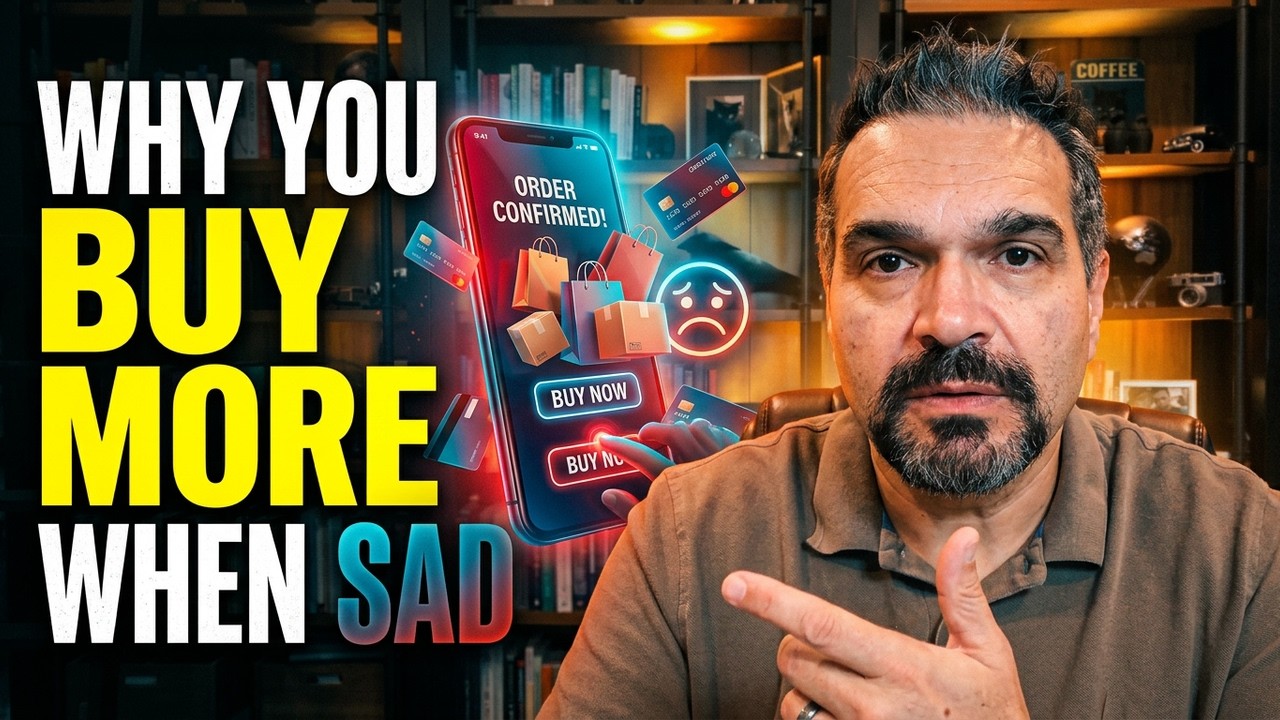
Three moods that make you easiest to sell to, a real scam manual, and the one habit that takes the pressure off.
The short version
- A strong mood changes what you'll pay. In one study, people who'd just watched a sad film offered almost four times as much for the same water bottle, and a later rerun found a smaller version of the same effect.
- Sad, angry and excited each have tells, and a good salesperson looks for them before the pitch starts.
- Before you spend, name the weather: say your mood out loud in one plain sentence, then ask whether tomorrow-you would say yes.
You’ve probably done your own version of this. It’s been a rough week, you go out for one thing, and you come home with three. And the person who sold them to you could see that rough week on you before you’d noticed it yourself.
That isn’t a hunch. In one experiment, people who had just watched a sad scene from an old movie offered almost four times as much for a plain water bottle as people who had watched a calm film about a coral reef. It was the same bottle. The only thing that changed was their mood.
I spent 30 years in marketing, and a big part of that job was knowing what mood the customer would be in. Here’s what that looks like from the other side of the counter, and what you can do about it.
The one idea: a hot state
When a feeling gets strong enough, it starts doing some of your thinking for you. I call that a hot state.
The clearest test of it I know comes from Amsterdam. Researchers asked about 200 office workers to pick a free snack they’d get a week later, either fruit or something like a candy bar. Some chose right before lunch, when they were hungry, and some right after, when they were full. The snack was a week away, so how hungry they were that day shouldn’t have mattered. It did. The hungry group picked a lot more junk food.
That’s the catch with a hot state. While you’re in it, you assume you’ll feel the same way later. And anyone selling to you would much rather you decide now, while the feeling is still running the show.
Mood 1: Sad, lonely or worn down
Back to the water bottle. Here’s the honest part: that first study was small, only about 30 people. Ten years later, the same lab ran it again with new people. The effect showed up again, but it was smaller. So sadness does make people pay more, just not four times more every time. The researchers’ explanation is that sadness turns your attention inward, and buying something feels like a way to fix the feeling.
What gives it away: you say more than you meant to. “It’s been a hard year,” to someone who only asked if you needed help finding anything. You stay and chat longer than you need to, because you’re buying company as much as the product. Romance scammers build a whole business on this, and so do a lot of the “opportunities” that show up right after a funeral or a layoff.
In fairness, plenty of people who notice you’re down are just being kind. More on where the line is below.
Mood 2: Angry or feeling wronged
Researchers have found that people who tend to run angry expect things to go their way. They rate risks as smaller and are more willing to gamble. A large replication with almost 800 people found the same pattern.
What gives it away: you walk in with a grievance. “I’m so done with my current provider.” You tell the story of how the last company ripped you off, and what you want most is for someone to take your side.
Here’s how it gets used. The pitch opens by agreeing with you. “Oh, those guys? They do that to everybody.” Now the salesperson is on your team, and you’re about to make a big switch while you’re still mad. Sometimes you really were ripped off, and switching is the right call. Just make that call after you’ve cooled off, not while you’re still on the phone with the person who agreed with you.
Mood 3: Excited or in a hurry
This one has a tell on the seller’s side too. The friendly small talk before a pitch (“How’s your day going? Any big plans this weekend?”) is partly there to find out whether you’re in a good mood.
What gives it away: you lean in, you’re nodding before they finish the sentence, and you ask how soon you can have it before you ask how much it costs. A skilled salesperson keeps that excitement up on purpose, because the feeling has an expiration date. Sleep on it, and the hot state cools off, and so does the sale. That’s why the deposit “to hold your spot” shows up right when you’re most excited.
Real deadlines exist, and sometimes the excitement is right. The check is simple: was the deadline there before they met you?
The scam manual, in one line
At the end of 2025, Reuters reported on two handbooks recovered from raided scam compounds in the Philippines. They’re step-by-step guides to building a fake online relationship and then moving the person into a fake investment. On day one, the plan is to share “emotional experiences.” Money doesn’t come up for days. One line sums up the whole strategy:
“As long as the emotions are in place, the client’s money will naturally follow.”
In other words, they read your mood first, and the pitch comes second. Nobody can read your mind, and they don’t need to. Your mood is showing, and they’re trained to look for it.
The fix: name the weather
You beat them to it. Before you make any decision that costs money, check your mood the way you’d check the weather before you leave the house. Say what mood you’re in, out loud, in one plain sentence. “I’m sad and I’m shopping.” “I’m angry and I’m about to switch.” “I’m excited and they want a deposit.”
It sounds too simple to work, but there’s decent evidence it helps. In one study, people who were afraid of spiders spent time close to a big, live tarantula, and some of them were asked to describe what they were feeling out loud. A week later, facing a different spider in a different room, those people got less physically worked up than the people who had tried to talk themselves out of the fear or distract themselves. They still said they felt just as scared. Their bodies just didn’t react as much.
Putting the feeling into words gives you a little distance from it. Once you’ve named it, you can ask the question the seller is hoping you won’t: would tomorrow-me say yes to this? If you can’t answer that, say “I’ll get back to you tomorrow,” and let tomorrow-you decide.
Naming the weather is also the first move of the Source Test, the check we use on this channel for anything that wants your money or your trust. Stake: who gets what if I say yes today? Source: is there anything behind this deal besides how I feel right now? Steelman: giving the other side a fair hearing. If I still want it tomorrow, maybe it really is a good deal.
Where the line is
Here’s the strongest argument against all of this: everybody reads moods. Every good doctor does it, and so does every good friend. A salesperson who notices you’re upset and says, “Come back next week,” is using the same skill for the opposite purpose. What matters is what they do with what they see. Do they slow you down, or hurry you up?
I’ve been on the other side of this. Right after the holidays, I ran campaigns built on one idea: you didn’t get what you really wanted, so take the gift money and buy it yourself. When gas prices spiked and people were furious at the pump, I sold commercial electric vans into that anger. The vans were a good product, but the anger is what got me the meeting. And every spring, when tax refunds landed, I pushed a luxury item nobody needed. I never had to read anyone’s mind. The calendar told me what mood people would be in.
You can’t hide your mood, and you don’t have to. You just have to notice it before anyone else does, and say it out loud.
Questions people ask
Why do I buy things when I’m sad?
Sadness tends to turn your attention inward, and buying something can feel like a way to fix the feeling. In one small study, people who had just watched a sad film offered almost four times as much for the same water bottle. A later rerun by the same lab found the effect again, but smaller.
What is a “hot state”?
It’s any moment when a feeling is strong enough to do some of your thinking for you. While you’re in one, you assume you’ll feel the same way later. In one study, hungry office workers picked far more junk food for a snack they wouldn’t get for a week.
Does being angry make you take more risks?
It tends to. People who often run angry rate risks as smaller and are more willing to gamble, and a large replication with almost 800 people found the same pattern. Salespeople use it by agreeing with your anger, then pitching a big switch while you’re still upset.
How do scammers use emotions?
They read your mood before they ask for anything. A scam manual recovered from a raided compound in the Philippines, reported by Reuters, tells workers to share “emotional experiences” on day one and wait days before mentioning money. Its summary line: “As long as the emotions are in place, the client’s money will naturally follow.”
How do you stop impulse buying?
Before you spend, name the weather: say your mood out loud in one plain sentence, like “I’m sad and I’m shopping.” Then ask whether tomorrow-you would say yes. If you can’t answer, say “I’ll get back to you tomorrow” and let tomorrow-you decide.
Sources
- Cryder, C. E., Lerner, J. S., Gross, J. J., & Dahl, R. E. (2008). Misery is not miserly: Sad and self-focused individuals spend more. Psychological Science 19(6), 525–530.
- Garg, N., Williams, L. A., & Lerner, J. S. (2018). The misery-is-not-miserly effect revisited: Replication despite opportunities for compensatory consumption. PLOS ONE 13(6).
- Read, D., & van Leeuwen, B. (1998). Predicting hunger: The effects of appetite and delay on choice. Organizational Behavior and Human Decision Processes 76(2), 189–205.
- Lerner, J. S., & Keltner, D. (2001). Fear, anger, and risk. Journal of Personality and Social Psychology 81(1), 146–159.
- Lu, Efendić & Feldman (2025). Registered replication of Lerner & Keltner (2001), n = 780. Journal of Personality and Social Psychology.
- Kircanski, K., Lieberman, M. D., & Craske, M. G. (2012). Feelings into words: Contributions of language to exposure therapy. Psychological Science 23(10), 1086–1091.
- McPherson, P., Huang, H., & Levine, A. (Dec 31, 2025). A scammer’s guide: How cybercriminals plot to rob a target in a week. Reuters.
When you buy something you later can't explain, is it usually sad, angry or excited running the show?
Read the full transcript
You've probably done your own version of this, but let's just imagine you've had a rough week, and you go out to buy one thing, but you come home with three different things. And the person selling to you could see that rough week on you before you'd even noticed it yourself.
So here's the proof. In one experiment, people who'd just watched a sad movie scene offered almost four times as much for a plain water bottle as people who'd watched a nature film. It's the same bottle, but the only thing that changed was their mood.
So here's what you're walking out of this video with: the three main moods that make you easiest to sell to, what gives each one away, and one sentence that takes most of the pressure off. Plus, a real scam manual recovered by police that spells out the whole strategy in one line.
I'm Allen Stafford, and I help people think clearly in a noisy world, and this is Think Sharper. I've spent 30 years in marketing, and a big part of that job was knowing what mood the customer would be in.
So before we get to the three moods, you need one idea, and it's a simple one. When a feeling gets strong enough, it starts doing some of your thinking for you. I'm going to call that a hot state, and it's the only piece of jargon in this video.
Here's the clearest test of it I know. Researchers in Amsterdam asked about 200 office workers to pick a free snack they'd get a week later, either fruit or something like a candy bar. Some chose right before lunch, when they were hungry, and some chose right after lunch, when they were full. The snack was a week away, so how hungry they were on the day they chose really shouldn't have mattered, but it did. The hungry group picked a lot more junk food than the other group.
And that's the catch with a hot state. While you're in it, you assume you'll feel the same way later. And anybody selling to you would much rather you decide now, while the feeling is still running the show.
Now, hunger is easy to spot. The next one is harder, because it usually looks like you just need a little pick-me-up.
All right, so mood one is sad, or lonely, or just worn down. Let's go back to that water bottle example. One group watched a sad scene from an old movie, and the other group watched a calm film about a coral reef. Then everyone got the chance to buy the same bottle, and the sad group offered almost four times as much.
Now, here's the honest part. That first study was small, only about 30 people in it. Ten years later, though, the same lab ran it again with new people. The effect showed up again, but it was smaller. So sadness does make people pay more, just not four times more every time. The researchers' explanation is that sadness turns your attention inward, and buying something feels like a way to fix the feeling.
So what gives it away? If you're the one shopping, you'll hear yourself say more than you actually mean to, to the salesperson. You might say something like, "It's been a hard year," or "a hard day," to a person who only asked you if you needed help finding anything. You stay and chat longer than you actually needed to. What you're doing is buying company as much as you're buying the product. Romance scammers build a whole business on this, and so do a lot of the opportunities that show up after a funeral or a layoff.
But in fairness, plenty of people who notice you're down are just being kind. And I'll come back to where the line is before we finish this video.
Sadness makes you want to fix a feeling, and anger does something riskier, because it makes you sure of yourself.
Mood two is angry, or feeling wronged. Researchers have found that people who tend to run angry expect things to go their way. They rate risks as smaller, and they're more willing to take a gamble. A large replication study with almost 800 people found the same pattern.
So what gives it away? You walk in with a grievance, something like, "I'm so done with my current provider." Sound familiar? You tell the story of how the last company ripped you off, and what you want more than anything is for someone to take your side.
And here's how it gets you. The pitch opens by agreeing with you. They'll say something like, "Oh, those guys? They do that to everybody." Now the salesperson is on your team, and you're about to make a big switch while you're still mad.
Now, to be fair, sometimes you really were ripped off, and switching is exactly the right call. Just make that call after you've cooled off, not while you're still on the phone with the person who just agreed with you.
Anger at least feels like a warning sign. The last mood feels great, which is why almost nobody checks it.
Mood three is excited, or in a hurry. This one has a tell on the seller's side too. The friendly small talk before a pitch, "How's your day going? Any big plans this weekend?", is partly there to find out whether you're in a good mood or not. In my video Every Sales Pressure Play Explained, I called that the mood check.
So what gives it away on your side? You lean in, you're nodding before they finish the sentence, and you ask how soon you can have it before you ask how much it costs.
A skilled salesperson keeps the excitement up on purpose, because the feeling has an expiration date. Sleep on it, and the hot state cools off, and so does the sale. That's why the deposit "to hold your spot" shows up right when you're most excited.
But to be fair, real deadlines do exist, and sometimes the excitement is right. The check is simple. Was the deadline there before they met you, or after?
So here's the scam manual I promised. At the end of last year, Reuters reported on two handbooks recovered from raided scam compounds in the Philippines. They're step-by-step guides to building a fake online relationship and then moving the person into a fake investment. On day one, the plan is to share emotional experiences. Money doesn't come up for days. And one line sums up the whole strategy: "As long as the emotions are in place, the client's money will naturally follow."
In other words, they read your mood first. The pitch comes second. Nobody can read your mind, and they don't really need to. Your mood is showing, and they're trained to look for it.
So, quick question before we get to the fix. Of those three, which one is yours? When you buy something you later can't explain, is it usually sad, angry or excited that's running the show for you? Put it in the comments. I'm curious whether this audience leans more sad or more angry.
So what do you do about it? You beat them to it. Before you make any decision that costs money, you check your mood the same way you check the weather before you leave the house. I call it naming the weather. You say what mood you're in, out loud, in one plain sentence.
It sounds too simple to work, but there's decent evidence it helps. In one study, people who were afraid of spiders spent time close to a big live tarantula. Some of them were asked to describe what they were feeling out loud while they did it. A week later, facing a different spider in a different room, those people got less physically worked up than the people who had tried to talk themselves out of the fear or distract themselves from it altogether. They still said they felt just as scared, but their bodies just didn't react as much.
So putting the feeling into words gives you a little distance from it. And once you've named it, you can ask the question the seller is hoping you won't: would tomorrow-me say yes to this? If you can't answer that, do what I covered in my video How to Not Be Manipulated: 4 Habits of People Who Rarely Fall For It. Say something like, "I'll get back to you tomorrow," and let tomorrow-you decide.
Naming the weather is also the first move of a check I use on this channel for anything that wants your money or your trust. It's called the Source Test, and it's three quick questions. Stake: who gets what if I say yes today? Source: is there anything behind the deal besides how I feel right now? And steelman, which just means giving the other side its fair hearing: if I still want it tomorrow, maybe it really is a good deal.
I put the Source Test on a free one-page card, with a line at the top to name the weather first. The link is in the description. Download it for free.
Earlier I said I'd come back to where the line is between someone reading your mood to help you and someone reading it to use you. So here's the strongest argument against everything in this video. Everybody reads your moods. Every good doctor does it, and so does every good friend. A salesperson who notices you're upset and says, "Come back next week," is using the same skill for the opposite purpose. What matters is what they do with what they see. Do they slow you down, or hurry you up?
I should tell you that I've been on the other side of this as well. Right after the holidays, I ran campaigns built on one idea: you didn't get what you really wanted, so take the gift money and buy it yourself. That's the sad window, dressed up as a treat. When gas prices spiked and people were furious at the pump, I sold commercial electric vans into that anger. The vans were a good product, but the anger is what got me the meeting. And every spring, when tax refunds landed, I pushed a luxury item nobody needed, and the whole pitch was about owning something that was yours and nobody else's. I never had to read anyone's mood. The calendar told me what mood people would be in.
Look, you can't hide your mood, and you don't have to. You just have to notice it before anyone else does, and say it out loud.
Naming the weather is one habit. I made a whole video on the four habits of people who rarely get manipulated at all, and it's right here on the screen. Why don't you start there?
Think Sharper. Stay Sovereign.
More from Think Sharper
 8:10
How to Not Be Manipulated: 4 Habits of People Who Rarely Fall For It
 7:08
7 Sales Tricks That Make You Say Yes (And the One Sentence That Stops Them)
Watch the full Psychological Manipulation playlist on YouTube →
One tactic, one tool, every week
The newsletter walks through each video in a few minutes of reading. Free, and easy to leave.