
Season 1 · Episode 2
The Alpha Wolf Is a Lie (Even the Guy Who Coined It Says So)
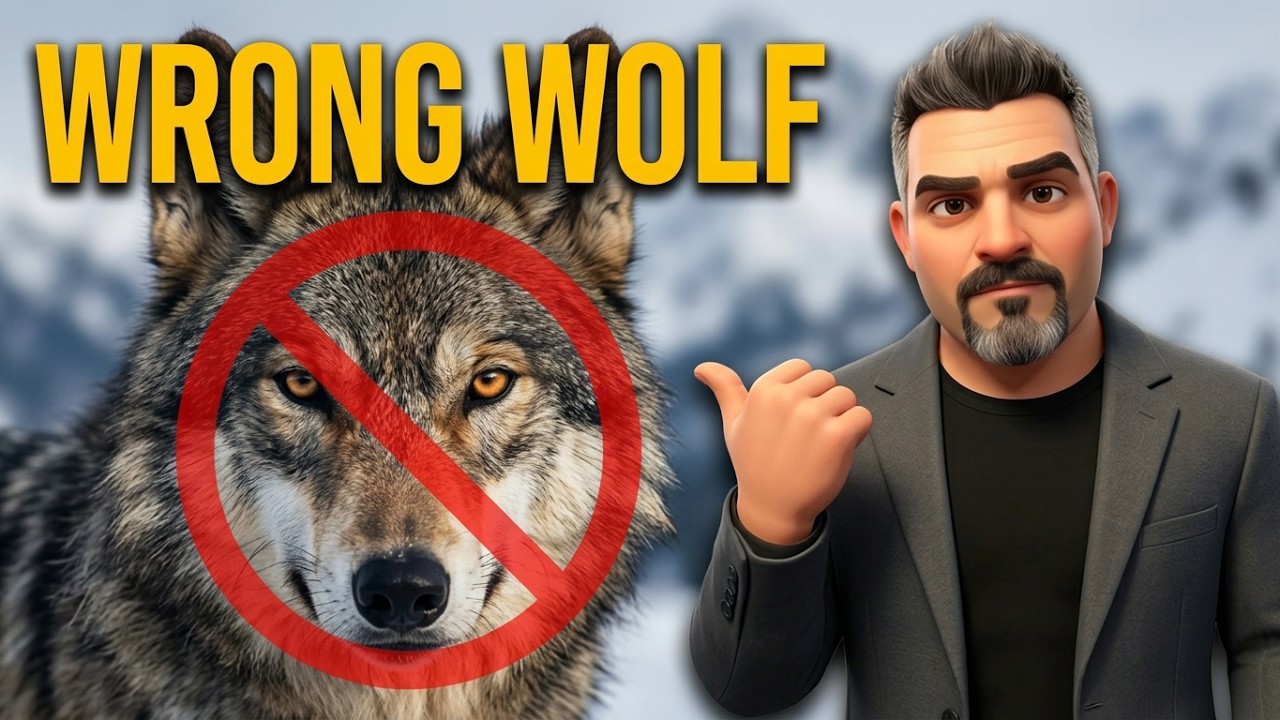
Where the alpha wolf really came from, what wild packs actually look like, and why "dominance is fake" is wrong too.
The short version
- The "alpha wolf" came from 1940s observations of unrelated wolves crammed together in a Swiss zoo. Wild packs are usually families, and the so-called alphas are just the parents.
- David Mech, the biologist whose 1970 book made "alpha wolf" famous, spent decades correcting it. His book finally went out of print in 2022.
- The popular correction overshoots. Dominance in wolves is real but situational, more like a parent correcting a grown pup than a king defending a throne.
In a wolf pack, the story goes, there’s an alpha: the strongest male, who fought his way to the top while everyone else fell in line. The loser rolls over and shows his belly. The winner eats first. From that one picture we got a whole vocabulary (alpha, beta, dominant, submissive) and a pile of self-help, dating advice and dog training built on top of it.
The picture is wrong. But the correction you’ve probably heard since, “wolf packs are just peaceful families and dominance is a myth,” is wrong too, and in a direction that flatters the people who repeat it.
Where the alpha wolf came from: a zoo
The idea traces back to Swiss animal behaviorist Rudolph Schenkel, who studied wolves at the Basel Zoo and published his findings in 1947. These weren’t wild wolves. They were unrelated adults, basically strangers, living together in an enclosure. And strangers forced together compete for position. Schenkel saw tension, rivalries and a top wolf, and he called it the alpha.
It’s a bit like studying people during a prison riot and deciding that’s how families work.
The idea went mainstream through The Wolf, a 1970 book by wolf biologist L. David Mech. It was a landmark book, and it put “alpha wolf” into popular culture.
The scientist who took it back
Mech then spent decades studying wild wolves, including summers on Ellesmere Island in the Canadian high Arctic, watching a pack so unused to people that it mostly ignored him. What he saw wasn’t a gang of rivals fighting for a throne. It was a family.
A typical wild pack is a breeding pair and their offspring from the past two or three years, often around six to ten wolves. The so-called alphas are simply the parents. They lead because they’re the parents, not because they won a fight. When the young wolves reach two or three years old, they usually leave to find mates and start packs of their own.
In a 1999 paper in the Canadian Journal of Zoology, Mech called the “top dog” picture “particularly misleading.” As he has put it, what would be the value of calling a human father “the alpha male”? He pushed for years to get his own book taken out of print, and in 2022 it finally was.
The second myth: “dominance in wolves is fake”
Here’s where the popular correction overshoots. Mech never said dominance doesn’t exist. He said the cartoon version, a wolf fighting unrelated rivals to become top dog, doesn’t describe wild packs.
Dominance in wolves is real. It’s just situational, more like a parent correcting a maturing pup than a king holding a crown. In 2010, Mech described watching an adult wolf pin another to the ground for about six and a half minutes.
Even “it’s always just Mom, Dad and the kids” is a little too tidy. In Yellowstone, the Druid Peak pack grew to 37 wolves in 2001. When a territory gets crowded, leaving home gets dangerous, so grown offspring stay longer, and some packs end up with more than one breeding pair. Wolves are families. Families get complicated.
How the myth got into your living room
The captive-wolf picture didn’t stay in zoology. In 1978, How to Be Your Dog’s Best Friend, a popular training book by the Monks of New Skete, taught owners the “alpha roll”: when a dog misbehaves, flip it on its back and pin it, the way a lead wolf supposedly would. A whole generation of owners tried it.
That isn’t how wild wolves run a family. Mech calls the real behavior “pinning,” and it’s situational, not a discipline routine. By their 2002 edition, the monks had dropped the technique themselves, calling it too risky and demanding for the average dog owner.
The thing to take with you
Notice what the myth and the correction have in common. Both turned wolves into a mirror. “Be the alpha” gave people permission to dominate. “Alphas aren’t real” gave people permission to believe dominance is always fake and always bad. Neither group was really talking about wolves.
And the one piece of the story people built a whole personality around, strangers fighting for rank in an enclosure, is the one piece that never described wild wolves at all.
So when a correction makes you feel smarter, calmer or more enlightened than the people who still believe the myth, stop and ask: does this version flatter me? The version that flatters you is the one you’ll stop checking.
Corrections to the video
Title: We said Mech coined “alpha wolf.” He popularized it in his 1970 book. Rudolf Schenkel’s 1947 paper used it first, as the video itself says.
About 3:50: We said wolves leave home at two or three. Mech’s own work says most disperse at one to two, some as young as nine months, and few stay past three.
About 4:58: We said Mech saw a six-and-a-half-minute pin in 2010. He saw it in July 2009, and the paper came out in 2010. It was repeated pinning over that time, and he called it an extreme case, the longest he’d seen in over 50 years.
0:16: We said there’s no such thing as an alpha wolf. Mech himself says “alpha female” is probably appropriate for the original matriarch in some large Yellowstone packs, and some researchers still use the term. What’s been rejected is the fight-to-the-top model for typical family packs.
About 6:30: We called alpha-style dominance a pure zoo artifact the wild never reproduced. It’s rare in typical family packs, but in Yellowstone’s Druid Peak pack, a dominant female was killed by packmates and her sister then took over.
About 1:15: We said alpha-male vocabulary all comes from wolves. Its spread to humans owes a lot to primatology. Frans de Waal says he’s partly responsible for the term through his book Chimpanzee Politics.
6:11: We said the alpha-male industry was never based on science, then said it took its idea from Schenkel. We can’t document that link. The clearer route runs through primatology and pickup-artist books.
About 2:14: We called Schenkel’s wolves unrelated strangers. That’s David Mech’s later description. Schenkel’s paper says their origin couldn’t be established and doesn’t state kinship.
About 2:10: We said Schenkel studied the wolves in the 1940s. His observations began in 1934, and the paper came out in 1947.
3:06: We implied Mech discovered the family structure on Ellesmere Island. It was in print by 1944, and even Schenkel footnoted it. Ellesmere gave him close-up evidence to reject the alpha framing.
About 4:48: We called wolf dominance situational, a parent correcting a pup. Mech describes a standing age-based order, shown mostly over food. The pinning case we cited was described as harassing a maturing offspring.
About 7:02: We said pinning isn’t how wild wolves run a family. Wild parents do pin offspring. What’s unsupported is treating it as a routine for dog owners to copy.
Questions people ask
Is the alpha wolf a myth?
Mostly. The idea of an alpha fighting rivals for control came from 1940s observations of unrelated wolves in captivity. In the wild, packs are usually families, and the leaders are the breeding parents.
Who came up with the alpha wolf idea?
Swiss behaviorist Rudolph Schenkel described it in 1947 from wolves at the Basel Zoo. Wolf biologist David Mech made it famous in his 1970 book, then spent decades correcting it.
Do wolves have a hierarchy?
Yes, but it’s family-based and situational. Pack members defer to the breeding parents, and dominance shows up in specific moments, not as a constant fight for rank.
What is the alpha roll, and does it work?
The alpha roll means pinning a dog on its back to assert dominance. The Monks of New Skete popularized it in 1978 and dropped it in their 2002 edition as too risky. It doesn’t reflect how wild wolves behave.
How big is a wolf pack?
Often around six to ten wolves: a breeding pair and their offspring from the past two or three years. Packs can grow much larger, like Yellowstone’s Druid Peak pack, which reached 37 wolves in 2001.
Sources
- Schenkel, R. (1947). Expression studies on wolves. Behaviour 1, 81–129.
- Mech, L. D. (1970). The Wolf: The Ecology and Behavior of an Endangered Species. Natural History Press.
- Mech, L. D. (1999). Alpha status, dominance, and division of labor in wolf packs. Canadian Journal of Zoology 77(8), 1196–1203.
- Scientific American. Is the Alpha Wolf Idea a Myth?
- International Wolf Center. International Wolf, Summer 2020.
- Science Friday. The Alpha Wolf Myth.
- Monks of New Skete (1978; 2nd ed. 2002). How to Be Your Dog’s Best Friend.
Where did you first hear someone called an "alpha male"? A podcast, a gym, a dating coach?
Read the full transcript
You've heard this one. In a wolf pack, there's an alpha. The strongest male. He fought his way to the top, and everyone below him fell in line. Be the alpha. Dominate. Lead the pack.
Except there's no such thing as an alpha wolf. That's a myth.
SMUG GUY: Right, the "alpha wolf" thing got debunked. Wolf packs are just families. Everybody knows that now.
Yeah. And that, the correction you're so proud of knowing, it's hiding a second myth. One you probably believe.
Welcome to the channel where we don't just bust the myth. We bust the correction. Today: the alpha wolf that never existed, the scientist who spent thirty years trying to kill it, and the lie still hiding inside the fix.
The story is everywhere. Wolves live in packs ruled by an alpha male and an alpha female. You claw your way up through dominance. Fights. Submission. The loser rolls over and shows his belly. The winner eats first.
And people ran with it. "Alpha male." "Beta." The whole vocabulary of who's dominant and who's weak, it all comes from this one picture of wolves. It's in self-help books, dating advice, business books, dog training. One clean rule: life is a hierarchy, and you fight to the top. It's simple. It's manly. It's on a thousand motivational posters. And it came from watching the wrong wolves.
Now here's where the informed crowd jumps in. And they're right, mostly.
SMUG GUY: Actually, that whole alpha thing is debunked. Wolf packs aren't ruled by some tough guy. They're just families, a mom and dad and their pups. "Alpha" isn't real.
And he's right. Here's where the myth came from. Back in the 1940s, a scientist named Rudolph Schenkel studied wolves, but he studied captive wolves, at a zoo in Switzerland. A bunch of unrelated adult wolves, strangers, crammed into an enclosure together. And strangers forced together fight for position. So that's what he saw: tension, dominance, a top wolf. He called it the "alpha."
The problem? That's not how wolves live in the wild. It's like studying humans in a prison riot and deciding that's just... how families work.
The idea got locked in by a 1970 book from a wolf biologist named David Mech, the most respected wolf researcher alive. His book made "alpha wolf" famous. And then he spent decades trying to take it back. He pushed for years to get his own book pulled, and in 2022, it finally went out of print. Imagine working that hard to un-sell your own bestseller.
So what changed his mind? Wild wolves. Mech spent summers on Ellesmere Island, way up in the Canadian high Arctic, watching a wild pack up close, wolves so unused to people that they mostly ignored him. And what he saw wasn't a gang of rivals clawing for the throne. It was a family.
A typical wild pack is a breeding pair and their kids from the last two or three years, usually somewhere around six to ten wolves. The so-called "alphas" are just... the parents. They're not in charge because they won a fight. They're in charge because they're Mom and Dad. And when the kids hit two or three years old, they leave home, find a mate, and start a pack of their own.
As Mech put it: what would be the value of calling a human father "the alpha male"? You don't run your household because you beat your teenager in a wrestling match. Hopefully.
So the correction is true. The alpha-fighting-to-the-top story is wrong. And this, this is exactly where the smug guy stops. Right where it makes him sound like he reads science. Which is the tell.
Because here's what he doesn't tell you. "Wolves are just peaceful families, dominance is a myth," that's also wrong. And it's wrong in the direction that flatters whoever's saying it.
Mech never said dominance doesn't exist. He said the cartoon version doesn't, the idea of a wolf fighting unrelated rivals to be "top dog." In his own 1999 paper, that's the part he called "particularly misleading." But dominance in wolves is absolutely real. It's just situational, a parent correcting a maturing pup, not a king holding a throne. In 2010, Mech himself watched an adult wolf pin another to the ground for six and a half minutes. Dominance didn't vanish. It just isn't a tournament.
So the people who heard "no alphas" and decided wolves are a leaderless peace commune? They overcorrected, because that version felt nicer.
And even "it's always just Mom, Dad and the kids" is a little too tidy. In Yellowstone, the Druid Peak pack grew to thirty-seven wolves in 2001. When a territory gets crowded, leaving home gets dangerous, so grown kids stick around, and some packs end up with more than one breeding pair. Wolves are families. But families get complicated. Sound familiar?
And notice what both the myth and the correction have in common: they're both really about you. Team "be the alpha" wanted permission to dominate. Team "alphas aren't real" wanted permission to believe dominance is always fake and bad. Each crowd took the wolves and made them a mirror.
And here's the twist that should bother everybody. The entire "alpha male" self-help industry? It was never based on the science in the first place. Not the real version, not even the debunked version. Think about it. Schenkel watched stressed, captive, unrelated wolves and saw dominance fights. The "be an alpha" crowd took that, the behavior of animals in a cage, under stress, that even the original researcher's own field couldn't reproduce in the wild, and sold it to you as the law of nature. The one piece everyone built a personality around is the one piece that was pure artifact of a zoo enclosure.
And it didn't stay at the gym. It got into your living room. In 1978, a popular dog-training book by the Monks of New Skete, yes, actual monks, taught owners the "alpha roll." Dog misbehaves? Flip it on its back and pin it down, like a wolf leader would. A whole generation of owners started wrestling their golden retrievers into submission in the name of nature.
Except that's not how wild wolves run a family. Mech calls the real behavior "pinning," and it's situational, not a discipline routine. By their 2002 edition, the monks had dropped it themselves, calling it too risky and demanding for the average dog owner. Even the monks recanted. When monks are walking it back, you know the idea got away from everybody.
So you've got three layers. The myth: alpha wolves fight to the top. Wrong. The correction: wolves are leaderless families, dominance is fake. Also wrong. And the truth: wolves have real, situational dominance inside what is basically a family, and none of it was ever a blueprint for how a human should act at the gym.
So here's the thing to take with you. When you hear a correction and it makes you feel smarter, calmer, more enlightened than the people who still believe the myth, stop. Ask: does this version flatter me? Because the version that flatters you is the one you'll stop checking. That's not where truth lives. That's where the next myth hides.
Even our friend here. He traded "be the alpha" for "alphas aren't real" and felt smarter for it. He just swapped one comfortable story for another. The hard part isn't picking the right wolf. It's noticing when a story is a little too flattering to question.
If that rearranged something in your head, subscribe. Every episode, we take a myth everybody "knows," and then we take apart the correction too.
Next time: Pluto. Everyone knows it "got demoted from a planet." Nobody can tell you what a planet even is. Turns out that's the whole problem. See you there.
WOLF: I'm the alpha of this pack.
CHIMP: You're a middle-aged dad who yells at his kids about screen time. Sit down, Kevin.
More from The Second Myth

Get the next myth first
New episodes and the sources behind them, in your inbox. Free, and easy to leave.